Rotary Dream Team – India 2011 by Barbara Fox
Combined Polio NID and Dam Construction
As the group from Canada , US and France prepare to depart to Delhi, India for the National Immunization Day (NID) and to participate in the catch dam project in Rajasthan, we ask for your support to meet the goal of US$21,500.00. More than half of this amount has already been raised and Elias Thomas (former District Governor District 7780, Maine, USA) has asked that each club contribute US$250.00 to the project. 
This catch dam project will enable farmers in three tiny villages to plant three crops rather than one, in an arid region that only gets one flooding rain a year. With the dam in place, water will be available for most of the year.
If you wish to contribute individually, please see below. As always thank you for your generosity.
Checks must be drawn on US Banks. (For those of you in Canada, our apologies – but we have encountered difficulties in the past). Checks should be made payable as follows:
Sanford-Springvale Rotary Club Charitable Fund, and on the MEMO line, indicate: India Water Project 2011. Send all checks to: Jackie Roberts, Treasurer Sanford-Springvale Rotary Club, Post Office Box 1166, Sanford, Maine 04073-1166
*****************************TRIP UPDATE ****************************
India
February 2011 NID and Dam Build
Walking the Talk
While I made my preparations for the journey to India, fellow Rotarians in Alaska, the lower 48, Canada, France, Iceland, Australia, Nova Scotia and the UK were also gearing up to meet in Delhi on the 14th of February, where the Dream Team was set to build a catch dam near a remote village Chahalka (near Sohna, in Haryana State) and administer Polio immunizations in Pinagwan.
The first stop enroute was Newark airport where the USA and Canada teams met for the direct flight to New Delhi India. After 13.5 hours in captivity aboard the crowded 777 we were met by High Points of India for transfer to our first hotel. There we joined our European counterparts and began our journey taking in a small part of the vast sub-continent that is India.
We were welcomed by the Delhi Megalopolis of New Delhi at an evening reception and met our Indian counterparts who we key in managing the connections for the Dam and the NID.
As we all became acquainted during our first days, we toured a few well known places including the Taj Mahal at Agra which is surprisingly more beautiful in reality than in any picture I have ever seen. We rode elephants up to the Amber Fort, an ancient sandstone fort outside of Jaipur that was reminiscent of the Great Wall of China as the walls snaked up and down the mountain side. Inside was a palace with 365 bedrooms. The intricate carvings and brick work was an amazing accomplishment for the 1.5 mile square edifice built in the 16-17 century.
After we ate lunch in Agra, there was a Muslim march in progress outside of the gates of the restaurant and we stood and watched until we were spit upon and the only police man that was in evidence suggested we go back in side the restaurant compound. Our women were in slacks with heads uncovered…he was afraid the disrespect may turn to violence. Rickshaws were hired to remove us from there, because our bus could not get through the crowd.
While in Jaipur, a young man with legs twisted by polio scooted along the street begging, we were told not to give money on the streets for fear of being overwhelmed. The irony of being here for an End Polio Now campaign and unable to help an obvious victim of the disease was not lost on any of us.
Next we stopped to watch fabric being printed by hand, silk and wool rugs woven and the rest of the processes of each, that are intensely manual labor, from the weaving, cutting, fringe knotting and washing. A visit to the camel hide shoe store where the shoes are so soft you can roll them up and put them in your pocket.
We took in the art of marble cutting and the inset of semi precious stones such as Lapis, Turquoise, Mother of Pearl, Carnelian and Malachite into intricate designs, again extremely labor intensive
At each one of these villages it is the same, the streets are a cacophony of sound and movement. The narrow street is shared by pedestrians, motorcycles, rickshaws, cars, buses, camels, free roaming dogs, goats and cows. Every manner of waste and excrement litter the streets and the women in their beautiful Sari’s with bundles on their head maneuver it with grace. The noise level is such that with the constant horn honking, sound of vehicles and the voices of vendors, beggars and humanity in general assault your senses along with the smells of cooking and the litter of the streets.
They begin their day of selling about 10 AM and stop around 8PM and if your up early enough and out on the street you see fires being started in the middle of the walk way of any available material that will burn to warm them after a night of sleeping on the street.
Whole families, up to as many as 5 ride on the small motorcycles at once; the women ride side saddle with a child or two in their arms. Twice we saw accidents; one, the veil of a woman caught in the spoke of the motorcycle and another hit a rock and threw the 3 passengers to the side of the road; they merely climbed back on and continued on their way.
The 3 wheel Tuk Tuk taxi designed to hold possibly 3 people and a driver are loaded with as many as 15, with the passengers crammed in sideways and on top of one another with others hanging on to the back.
Dump trucks, transports and tractors in surprising number are never a one occupant vehicle. The large trucks have signs on the back of their colorfully personalized, decorated trucks saying blow horn, as if anyone needs encouragement to do so. Everyone drives as fast as they can with no regard to lanes and there can be as many as 4 to5 lanes made across on a two lane road, as you can imagine this cause’s frequent grid lock.
Our next tourist destination was the Ganges River. We wove our way down a narrow street Bazaar and came to the River; moored there at the bottom of the steps was a 100 year old wooden boat owned for 4 generations by the same family. Once on board, we looked at our previously packed lunch and decided to give it to the children that sat on the steps. We gave it to a local man to distribute and as we pulled away from the dock, he had the children lined up and was breaking apart the sandwiches to hand out.
Several miles down the Ganges we watched a cremation at river side, crossed under a large pontoon bridge that required that we help dismantle the top part of the boat that held the shade cloth until we passed under. The cruise ended at the steps where an evening prayer service was held. Singing, chanting, incense and colorful costumes were part of the service. We sat on the boat as did many others; vendors selling floating candles plied their goods stepping easily from one boat to another, so closely packed were the number of boats on the river.
Once the one hour ceremony ended, the boat was docked a little further down and we disembarked and climbed the very steep 70 + steps (ghat) to the top. Along the way were many beggars, blind, lepers, amputees, cripples and the desperately poor pleading with their hands, bowls and cups. At the top rickshaws waited to return us to the hotel in Veranasi. Our driver decided he did not want Rickshaw carrying another of our group to pass him and in the race nearly over turned us into oncoming traffic.
Our guides gave us some history and back ground of some of the places we went. On our visit to Old Delhi, we were told that they were happy for the British occupation because they united India which previously had been separated by the individual Rajahs and Maharajahs kingdoms. Many of the Royal families exist today under other political or business venues. The people seem to revere their Maharajas.
At last we are headed for the Dam site where a tent city has been erected for the 4 days we will work on the dam. The tents are very luxurious and clean in comparison to some of the hotels we stayed.
The group, after being confined on buses elected to walk the 3 miles to the dam site the evening we arrived just to check it out. In the wilderness with goats and cows watching us we arrived at the Dam and found the local masons had completed a 6 by 6 portion of the base that would eventually end up being 12 by 24. The natural gorge where the water will back up on completion of the dam and the onset of the monsoon season will span the width of the 123 foot gorge and rise about 12 feet.
When we returned to the dam the next day with our contingent of 51 Rotarians and without any mechanical tools of any sort, we moved tons of Rock from the size of small boulders to fist sized rocks to construct the base of the dam. The process was to move in the larger rock or boulders, fill in with smaller rocks then fill with water from the tanker (it didn’t look like it would hold anything let alone water, but was surprising leak free) then fill in with dry cement mix and the masons would carefully arrange the rocks so that empty space was kept to a minimum, thereby using less masala (mix). By the end of that day, we had a 12 by 24 base down and the masons were setting the level for the first part of the wall rise.
We utilized stainless steel basins for transporting, bucket brigade style, the rocks, dirt, sand, cement and water to the build. We gathered small rocks from the surrounding fields and passed them down for fill. Large hoes were used to dig a trench that was filled with good sized boulders manhandled (muscled) into place by some of our Rotaract group from Iceland and other men. Back breaking, hernia inducing labor!
We returned in the evening to our tents, a shower, hot meal and various pain and muscle relief. That night was very cold, but the beds were comfortable and warm. We woke to fog, dressed and headed back to the dam.
The masons had completed about 5 feet of the first wall. It is amazing to watch them walk effortlessly over the rough rocks and boulders in their rubber flip flops. The local children are equally as agile, with young 7-8 year old girls with a 6 month old baby on their hip running over the same rugged terrain.
The locals have gathered to watch and as they grasped what we were doing and joined in to help, especially the 7-9 year old boys. The teenage boys stood around arrogantly watching saying that they, with their 5th grade education, were too educated to stoop to such labor. By the time the last day rolled around, some of them had changed their attitude and we got some buy in…it was gratifying to see they understood what we were doing for them.
When we left the dam site, we had a 12 foot base, and a 6 foot wall, and it was left to the 20 local men coming in the next week to bring it to completion in approximately a month. A side benefit is that the dam will raise the water table and some wells that have been dry, will once again contain water.
Sunday morning our day of departure and the NID, we were in a motel in Sohna, from there we continued to the NID rally held in Pinagwan. With drummers we moved and danced through the streets and back alleys of the village for about an hour making the population aware of our presence and the reason for it. It is here we met with the Alaskan contingent of 25 people who came specifically for the NID.
Once the rally was over we returned to Sohna for the night. We were told that the next day there was going to be a Muslim rally in the NID village in the afternoon, so we were to go early in the morning, do the immunizations and get out thereby avoiding a possible problem.
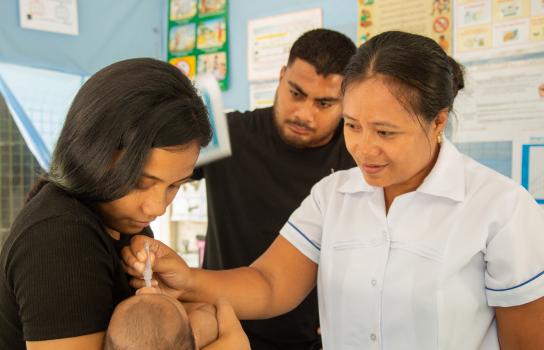
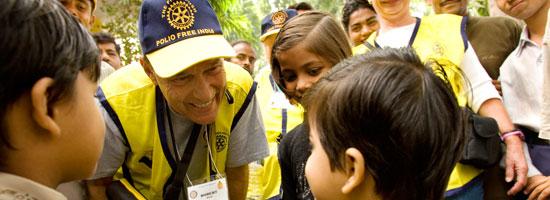
Our group immunized 140 at our post. We were with an extended Indian family in a small gated compound, they invited us for lunch which they prepared in the open court yard, they spread a rug on one of the rope beds and gave us possibly the best meal I had in my stay in India. If we commented on the beauty of something, jewelry, earrings, etc they would immediately take it off and make it a gift to us, we ceased commenting on things. They continued with their warm, generous hospitality when the Chai tea, made by the grandmother, was served. When they started dragging the rope beds back under their shelter and invited us to take a community nap, we declined and decided to walk out of the back streets and back to the compound where everyone was to return after they were finished with immunizations at their assigned posts.
When we connected with the main road we remembered the advice of the locals; crossing a street is a matter of commitment, with all manner of traffic moving without regard to lanes, the local advice is to start walking and do not stop, because theoretically all the drivers see you and gauge their progress toward you. Therefore once you commit, do not stop moving. Pedestrians are the least accommodated of the movement on the street, no traffic lights, no stop signs no sidewalks and no pedestrian cross walks.
At the Sohna motel, we changed and packed for the trip home and said our goodbyes to our new friends, because once at the airport we would separate for our various flights to home destinations.
After another nearly 14 hours in flight (7546 mi.) it is a great relief to touch down in the USA at Newark and receive a welcome home from the Customs agent.
My connecting flight to Denver was delayed an hour on the tarmac, but was eased somewhat by the half full plane and room to move about. I am impatient to get back to Denver and see familiar faces after spending 15 days with relative strangers.
I was fortunate to take part in Rotarians walking the talk at the dam, and the NID, seeing the computer lab and generator donated by another Rotary club and the general good will generated by the participants of the Dream Team 2001.
We can be proud to be Rotarians!
|